Choosing the Right Mining Hardware
Matching the correct ASIC miner to the right solar installation is the most important decision in a solar mining build. The wrong pairing wastes money on both sides of the equation.
The Most Important Metric: J/TH
Energy efficiency is measured in joules per terahash (J/TH). A lower J/TH value means the miner produces more hashing power per watt of electricity consumed.
For solar miners, J/TH is even more critical than it is for grid-connected operations. Every watt saved by the miner directly reduces the size and cost of the solar array you need to power it.
Modern high-efficiency ASICs from manufacturers like Bitmain and MicroBT reach efficiencies below 20 J/TH. Older generation hardware often sits above 50 J/TH and is rarely worth running on solar.
Hashrate and Power Draw
Hashrate tells you how many calculations per second the miner performs. A higher hashrate increases your share of block rewards, but it also comes with a higher power draw.
For a solar setup you must know the miner's exact watt figure and plan your panel and battery capacity around that number. Adding a 20% safety margin is a sensible approach for cloudy days and seasonal variation.
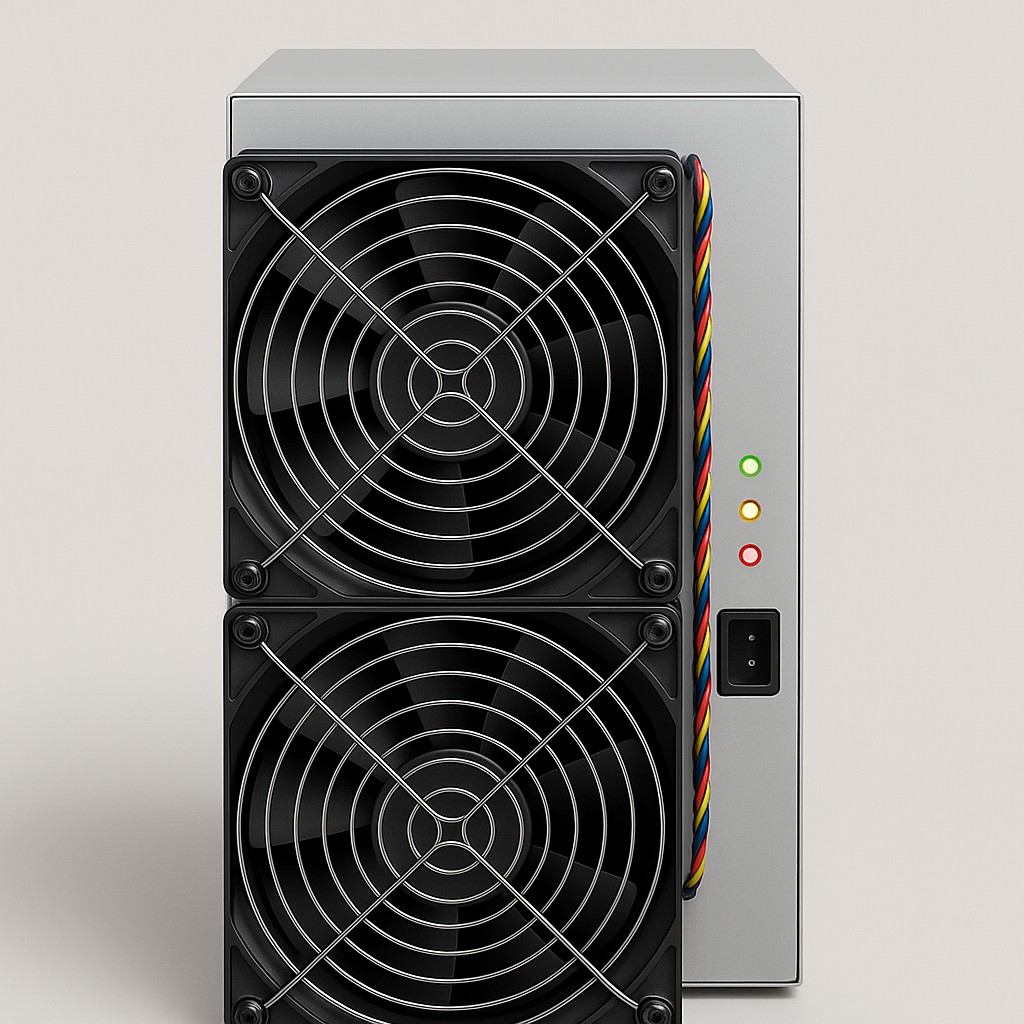 The front panel of an Antminer unit shows the intake fans and status LEDs that indicate operating state and hash board health.
 Monocrystalline panels deliver the highest efficiency per square meter, which is especially important when roof or ground space is limited.
Choosing Solar Panels
Monocrystalline panels are the standard choice for mining applications because of their superior efficiency in limited space. Polycrystalline panels cost less but require more surface area for the same output.
Panel wattage has increased rapidly in recent years. 400 to 550-watt panels are now common and offer an excellent price-per-watt ratio. Bifacial panels can add 10 to 20 percent extra yield by capturing reflected light on the rear side.
Always check the panel's temperature coefficient. A lower coefficient means the panel loses less efficiency on hot days, which matters a great deal if your mining location has high summer temperatures.
Charge Controllers and Inverters
A maximum power point tracking (MPPT) charge controller extracts the optimal energy from the panels in all light conditions. MPPT controllers outperform the older PWM type by 15 to 30 percent in real-world conditions.
Size your inverter to handle the combined watt draw of all miners plus a comfortable headroom. An undersized inverter creates a bottleneck and limits your expansion options later.
Compare Mining Hardware Before You Buy
Choosing the wrong miner is an expensive mistake. MinerCompare lets you compare ASIC miners side by side across all key specifications, including hashrate, power draw, efficiency, and estimated profitability.
MinerCompare.com
The independent comparison tool for ASIC mining hardware. Find the most efficient miner for your solar budget in minutes.
A practical rule of thumb: your solar array should be rated at 1.3 to 1.5 times the total watt draw of your miners. This buffer accounts for cloudy days, panel degradation, and conversion losses in the inverter and charge controller.
Learn How Solar Energy Cuts Your Mining Costs
Go back to the fundamentals and understand the physics behind your free power source.